Meaning of Pressure
Pressure is defined as:
The force acting per unit area on a surface.
Pressure tells us how concentrated a force is over an area.
Formula for Pressure
Where:
- P = pressure (pascals, Pa)
- F = force (newtons, N)
- A = area over which the force acts (square metres, m²)
Unit definition:
How Force Affects Pressure
- Increasing force (area constant) → pressure increases.
- Decreasing force (area constant) → pressure decreases.
Example: Pressing harder on the ground increases the pressure on the ground.
How Area Affects Pressure (Exam-Critical)
- Smaller area (same force) → greater pressure.
- Larger area (same force) → smaller pressure.
This explains many everyday applications.
[Insert diagram showing the same force acting on small vs large area]
Everyday Applications of Pressure
Sharp Objects
- Knives, needles, pins have small contact areas.
- For the same force, they produce high pressure, making cutting and piercing easier.
[Insert diagram showing knife edge vs blunt surface]
Wide Surfaces to Reduce Pressure
- Snow shoes, camel feet, tractor tyres have large contact areas.
- This reduces pressure and prevents sinking.
[Insert diagram showing camel feet or snow shoes]
High-Heeled Shoes
- High heels have small area of contact.
- They produce high pressure, which can damage floors or soft ground.
Worked Examples (Teaching Core)
Example 1: Calculating Pressure
A force of 100 N acts on an area of 0.5 m².
Calculate the pressure.
Solution
Example 2: Effect of Area Change
A force of 200 N acts on:
- (a) area = 2 m²
- (b) area = 0.5 m²
Solutions
Smaller area → higher pressure.
Example 3: Finding Force
A pressure of 300 Pa acts over an area of 0.2 m².
Calculate the force.
Rearranging:
Visual Aid: Formula Triangle
[Insert formula triangle with P at the top, F and A at the base]
Key Examination Tips (High-Value)
- Always convert area to m².
- Do not confuse pressure (Pa) with force (N).
- State the formula before substituting values.
- Use realistic units and values.
Common Examination Errors (Examiner Insight)
Students often:
- use cm² instead of m² without converting,
- say pressure increases with area (incorrect),
- confuse mass with force,
- omit units in final answers.
Remember: pressure depends on both force and area.
Questions
Question 1
Define pressure.
Question 2
A force of 50 N acts on an area of 0.25 m².
Calculate the pressure.
Question 3
Explain why a sharp knife cuts better than a blunt one.
Question 4
A camel can walk on sand without sinking deeply.
Explain this using pressure concepts.
Solutions
Solution 1
Pressure is the force acting per unit area.
Solution 2
Solution 3
A sharp knife has a smaller contact area, producing higher pressure for the same force.
Solution 4
The camel’s wide feet increase the contact area, reducing pressure on the sand and preventing sinking.
End-of-Objective
A learner who has mastered this objective can:
- define pressure accurately,
- relate pressure to force and area,
- apply correctly,
- explain everyday pressure applications clearly.
Meaning of Atmospheric Pressure
Atmospheric pressure is defined as:
The pressure exerted by the weight of air in the Earth’s atmosphere on all objects on the Earth’s surface.
Air has mass, and due to gravity, it exerts a force. This force acting over an area produces pressure.
Key Characteristics of Atmospheric Pressure
- Acts in all directions (upwards, downwards, and sideways).
- Acts on solids, liquids, and gases.
- Decreases with increase in altitude (height above sea level).
- Normally not noticed because it acts equally in all directions.
Effects of Atmospheric Pressure
(a) Atmospheric Pressure on Liquids
Atmospheric pressure allows liquids to:
- remain in containers,
- rise into straws or syringes when pressure inside is reduced.
Example: Drinking through a straw
- Air pressure inside the straw is reduced when air is sucked out.
- Atmospheric pressure on the liquid surface pushes the liquid up the straw.
[Insert diagram showing liquid rising in a straw due to atmospheric pressure]
(b) Atmospheric Pressure and Containers
Atmospheric pressure can cause containers to:
- collapse if air inside is removed.
Example: Collapsing can
- When air inside a can is removed or cooled, internal pressure decreases.
- External atmospheric pressure pushes the can inward.
[Insert diagram showing a collapsing can experiment]
(c) Atmospheric Pressure on the Human Body
- Atmospheric pressure acts on the human body at all times.
- The body does not collapse because internal body pressure balances external pressure.
- Changes in pressure can affect the ears (e.g. during climbing or flying).
Example: Ear popping
- Occurs due to pressure difference between the inside and outside of the ear.
(d) Atmospheric Pressure and Weather
Atmospheric pressure influences:
- wind movement,
- weather patterns,
- formation of clouds and rain.
Air moves from regions of high pressure to low pressure, producing wind.
(e) Atmospheric Pressure at High Altitudes
At higher altitudes:
- atmospheric pressure is lower,
- less oxygen is available,
- breathing becomes more difficult.
Examples
- Mountain climbers,
- Aircraft cabins (pressurised).
[Insert diagram showing pressure decreasing with altitude]
Why We Are Not Crushed by Atmospheric Pressure
Although atmospheric pressure is large:
- it acts uniformly in all directions,
- internal pressure inside the body balances it.
Hence, there is no net crushing force.
Summary of Effects (Exam-Ready)
| Situation | Effect of Atmospheric Pressure |
|---|---|
| Straw drinking | Liquid pushed up |
| Collapsing can | Container crushed |
| Ears popping | Pressure imbalance |
| High altitude | Reduced oxygen |
| Weather | Wind formation |
Common Examination Errors (Examiner Insight)
Students often:
- say air has no weight (incorrect),
- think atmospheric pressure acts only downward,
- confuse atmospheric pressure with liquid pressure,
- fail to explain effects clearly.
Always mention air exerts force due to its weight.
Exam-Style Questions (Original)
Question 1
What is meant by atmospheric pressure?
Question 2
Explain why liquid rises when drinking through a straw.
Question 3
Describe what happens when a sealed can is crushed and explain why.
Question 4
Explain why breathing becomes difficult at high altitudes.
Worked Solutions (Beyond Excellent)
Solution 1
Atmospheric pressure is the pressure exerted by the weight of air on objects on the Earth’s surface.
Solution 2
Sucking air from the straw reduces the pressure inside it, so atmospheric pressure on the liquid surface pushes the liquid up the straw.
Solution 3
When the air pressure inside the can decreases, the greater external atmospheric pressure crushes the can inward.
Solution 4
At high altitudes atmospheric pressure is lower, so less oxygen enters the lungs during breathing.
End-of-Objective
A learner who has mastered this objective can:
- define atmospheric pressure correctly,
- describe its effects using real-life examples,
- explain pressure-related phenomena logically,
- answer structured and explanatory exam questions confidently.
What Is a Mercury Barometer?
A mercury barometer is an instrument used to measure atmospheric pressure using a column of mercury supported by the pressure of the atmosphere.
It works on the principle that:
Atmospheric pressure can support a column of liquid.
Construction of a Simple Mercury Barometer
A simple mercury barometer consists of:
- A long glass tube, sealed at one end
- The tube is completely filled with mercury
- A mercury reservoir (trough or container)
- The open end of the tube is placed below the mercury surface in the reservoir
When the tube is inverted:
- Some mercury flows out into the reservoir
- A column of mercury remains in the tube
At the top of the mercury column is a vacuum, called a Torricellian vacuum.
[Insert labelled diagram of a simple mercury barometer]
How the Mercury Barometer Works
- Atmospheric pressure acts on the surface of mercury in the reservoir
- This pressure pushes mercury up the glass tube
- The mercury rises until:
- the pressure due to the mercury column balances atmospheric pressure
At sea level:
- The height of the mercury column is about 760 mm
This height is a measure of atmospheric pressure.
Relationship Between Mercury Height and Atmospheric Pressure
- High atmospheric pressure → mercury column rises
- Low atmospheric pressure → mercury column falls
Thus:
The height of the mercury column is directly related to atmospheric pressure.
Use of the Mercury Barometer
The mercury barometer is used to:
- measure atmospheric pressure,
- study weather changes,
- predict weather conditions.
Weather indication
- Rising mercury → high pressure → fair weather
- Falling mercury → low pressure → cloudy or rainy weather
Why Mercury Is Used
Mercury is suitable because:
- it has very high density (short column needed),
- it does not wet glass,
- it produces a clear, visible column.
Units of Atmospheric Pressure (BGCSE Level)
Atmospheric pressure may be expressed as:
- millimetres of mercury (mmHg)
- pascals (Pa) (introduced later)
At sea level:
- Atmospheric pressure ≈ 760 mmHg
Summary of Key Points (Exam-Ready)
| Feature | Description |
|---|---|
| Instrument | Mercury barometer |
| Liquid used | Mercury |
| Principle | Atmospheric pressure supports liquid column |
| Vacuum | At top of tube |
| Normal reading | ~760 mm at sea level |
| Use | Measuring atmospheric pressure |
Common Examination Errors (Examiner Insight)
Students often:
- say mercury is pulled up by suction (incorrect),
- forget the presence of a vacuum at the top,
- confuse mercury barometer with aneroid barometer,
- fail to relate height change to pressure change.
Always state that atmospheric pressure pushes mercury up.
Questions
Question 1
What is a mercury barometer?
Question 2
Describe the construction of a simple mercury barometer.
Question 3
Explain how a mercury barometer measures atmospheric pressure.
Question 4
State what happens to the mercury column when atmospheric pressure decreases.
Solutions
Solution 1
A mercury barometer is an instrument used to measure atmospheric pressure using a column of mercury.
Solution 2
It consists of a long glass tube filled with mercury, inverted into a mercury reservoir, with a vacuum at the top of the tube.
Solution 3
Atmospheric pressure pushes mercury up the tube until the pressure due to the mercury column balances the atmospheric pressure.
Solution 4
The mercury column falls because the atmospheric pressure supporting it decreases.
End-of-Objective
A learner who has mastered this objective can:
- describe the structure of a mercury barometer,
- explain clearly how it works,
- relate mercury height to atmospheric pressure,
- apply the concept to weather and pressure changes.
Weather Charts and Isobars
A weather chart is a map that shows:
- atmospheric pressure,
- weather conditions over a wide area.
An isobar is defined as:
A line drawn on a weather chart joining points of equal atmospheric pressure.
Isobars are usually labelled in millibars (mb).
[Insert labelled weather chart showing isobars]
Units of Pressure Used on Weather Charts
- Atmospheric pressure on weather charts is measured in millibars (mb).
- Typical sea-level pressure is about 1013 mb.
Pressure values:
- Above 1013 mb → high pressure
- Below 1013 mb → low pressure
High-Pressure Systems (Anticyclones)
A high-pressure area is a region where atmospheric pressure is higher than surrounding areas.
Isobar pattern
- Isobars form closed loops,
- Pressure increases towards the centre,
- Isobars are often widely spaced.
Weather conditions
- Clear skies,
- Dry and sunny weather,
- Light winds.
[Insert diagram showing high-pressure isobar pattern]
Low-Pressure Systems (Depressions)
A low-pressure area is a region where atmospheric pressure is lower than surrounding areas.
Isobar pattern
- Closed loops,
- Pressure decreases towards the centre,
- Isobars often closely spaced.
Weather conditions
- Cloudy skies,
- Rain or storms,
- Strong winds.
[Insert diagram showing low-pressure isobar pattern]
Wind Direction from Isobars
Wind direction depends on pressure differences.
Key rules:
- Wind blows from high pressure to low pressure.
- The greater the pressure difference, the stronger the wind.
- Winds do not move directly across isobars; they tend to flow along curved paths around pressure systems.
Simplified BGCSE rule
Wind blows from regions of high pressure to regions of low pressure.
[Insert diagram showing wind direction relative to isobars]
Wind Strength and Isobar Spacing (Exam-Critical)
- Closely spaced isobars → strong winds
- Widely spaced isobars → weak or gentle winds
This is because:
- Close isobars indicate a large pressure gradient,
- Large pressure gradient produces stronger winds.
[Insert comparison diagram: close vs wide isobars]
Predicting Weather Using Isobars (Step-by-Step)
To predict weather from a chart:
- Identify pressure values (in mb).
- Locate high-pressure and low-pressure areas.
- Observe isobar spacing.
- Predict:
- type of weather (clear or rainy),
- wind strength (strong or weak),
- general wind direction.
Summary Table (Exam-Ready)
| Feature | Interpretation |
|---|---|
| High pressure (>1013 mb) | Clear, dry, calm weather |
| Low pressure (<1013 mb) | Cloudy, rainy, windy weather |
| Close isobars | Strong winds |
| Wide isobars | Light winds |
| Wind movement | From high to low pressure |
Common Examination Errors (Examiner Insight)
Students often:
- confuse isobars with contour lines,
- say wind blows from low to high pressure (incorrect),
- ignore isobar spacing when describing wind strength,
- forget pressure units (millibars).
Always mention isobar spacing and pressure values.
Questions
Question 1
What is an isobar?
Question 2
Explain how isobar spacing indicates wind strength.
Question 3
Describe the type of weather associated with a low-pressure system.
Question 4
A weather chart shows closely spaced isobars around a low-pressure centre.
Predict the weather conditions and explain your answer.
Solutions
Solution 1
An isobar is a line drawn on a weather chart joining points of equal atmospheric pressure.
Solution 2
Closely spaced isobars show a large pressure difference over a short distance, producing strong winds.
Solution 3
Low-pressure systems are associated with cloudy skies, rainfall, and strong winds.
Solution 4
The weather is likely to be windy and rainy because the closely spaced isobars indicate strong winds and the low-pressure centre causes rising air and cloud formation.
End-of-Objective
A learner who has mastered this objective can:
- interpret isobar patterns confidently,
- use pressure values in millibars correctly,
- predict weather conditions accurately,
- explain wind strength and direction clearly in exam answers.
Pressure in Fluids
Fluids (liquids and gases) exert pressure because:
- they have mass, and
- they are affected by gravity.
In liquids, pressure increases with depth because:
- the deeper you go, the more liquid is above you,
- the weight of this liquid exerts a force.
Factors Affecting Pressure Beneath a Fluid Surface
The pressure at a point beneath a liquid surface depends on:
- Depth of the liquid (h)
- Density of the liquid (ρ)
- Gravitational field strength (g)
It does not depend on:
- the shape of the container,
- the surface area of the liquid.
Formula for Pressure in a Liquid
Where:
- P = pressure (Pa)
- ρ = density of the liquid (kg m³)
- g = gravitational field strength (≈ 10 m s²)
- h = depth below the liquid surface (m)
Interpretation of the Formula (Exam-Critical)
From :
- Increasing depth (h) → pressure increases
- Increasing density (ρ) → pressure increases
- At the surface (h=0) → pressure due to liquid is zero
Visual Concept: Pressure Increasing with Depth
[Insert diagram showing liquid in a container with pressure increasing downward]
Worked Examples (Teaching Core)
Example 1: Effect of Depth
Calculate the pressure due to water at a depth of 5 m.
(Take density of water = 1000 kg m³, .)
Solution
Example 2: Effect of Density
Two liquids have the same depth of 2 m:
- Liquid A: density = 800 kg m³
- Liquid B: density = 1000 kg m³
Calculate the pressure in each liquid.
Solutions
Liquid A:
Liquid B:
Conclusion:
Higher density → higher pressure at the same depth.
Example 3: Finding Depth
A pressure of 30 000 Pa is measured in water.
Find the depth.
Everyday Applications of Liquid Pressure
Dams and Water Tanks
- Dams are thicker at the bottom.
- Pressure is greater at larger depths.
[Insert diagram showing a dam thicker at the bottom]
Divers and Submarines
- Pressure increases as divers go deeper.
- Divers must ascend slowly to avoid injury.
Water Jets from Holes
- Water flows faster from holes at the bottom of a container.
- Lower holes are at greater depth → higher pressure.
[Insert diagram showing water jets from different depths]
Key Examination Tips (High-Value)
- Use metres, not centimetres, for depth.
- Use correct density values (e.g. water ≈ 1000 kg m⁻³).
- Always include units.
- Pressure calculated using ρgh is liquid pressure only, not atmospheric pressure (unless stated).
Common Examination Errors (Examiner Insight)
Students often:
- forget to convert cm to m,
- confuse density with mass,
- use P=AF instead of ρgh,
- say pressure depends on container shape.
Remember: depth and density are the key factors.
Questions
Question 1
State the formula used to calculate pressure beneath a liquid surface.
Question 2
Calculate the pressure at a depth of 4 m in oil of density 900 kg m³.
(Take .)
Question 3
Explain why pressure at the bottom of a swimming pool is greater than near the surface.
Question 4
Explain why dams are built thicker at the bottom than at the top.
Solutions
Solution 1
Solution 2
Solution 3
Pressure increases with depth because more liquid above exerts greater weight and force.
Solution 4
The pressure of water increases with depth, so the bottom of the dam experiences greater pressure and must be stronger.
End-of-Objective
A learner who has mastered this objective can:
- relate liquid pressure to depth and density,
- apply P=ρgh correctly,
- apply correctly,
- solve numerical problems confidently,
- explain real-life applications of fluid pressure clearly.
OBJECTIVE
Describe how a manometer is used to measure pressure
What Is a Manometer?
A manometer is an instrument used to measure pressure, especially:
- gas pressure,
- pressure difference between a gas and the atmosphere,
- pressure difference between two gases.
It works by comparing pressures using a column of liquid.
Construction of a Simple Manometer
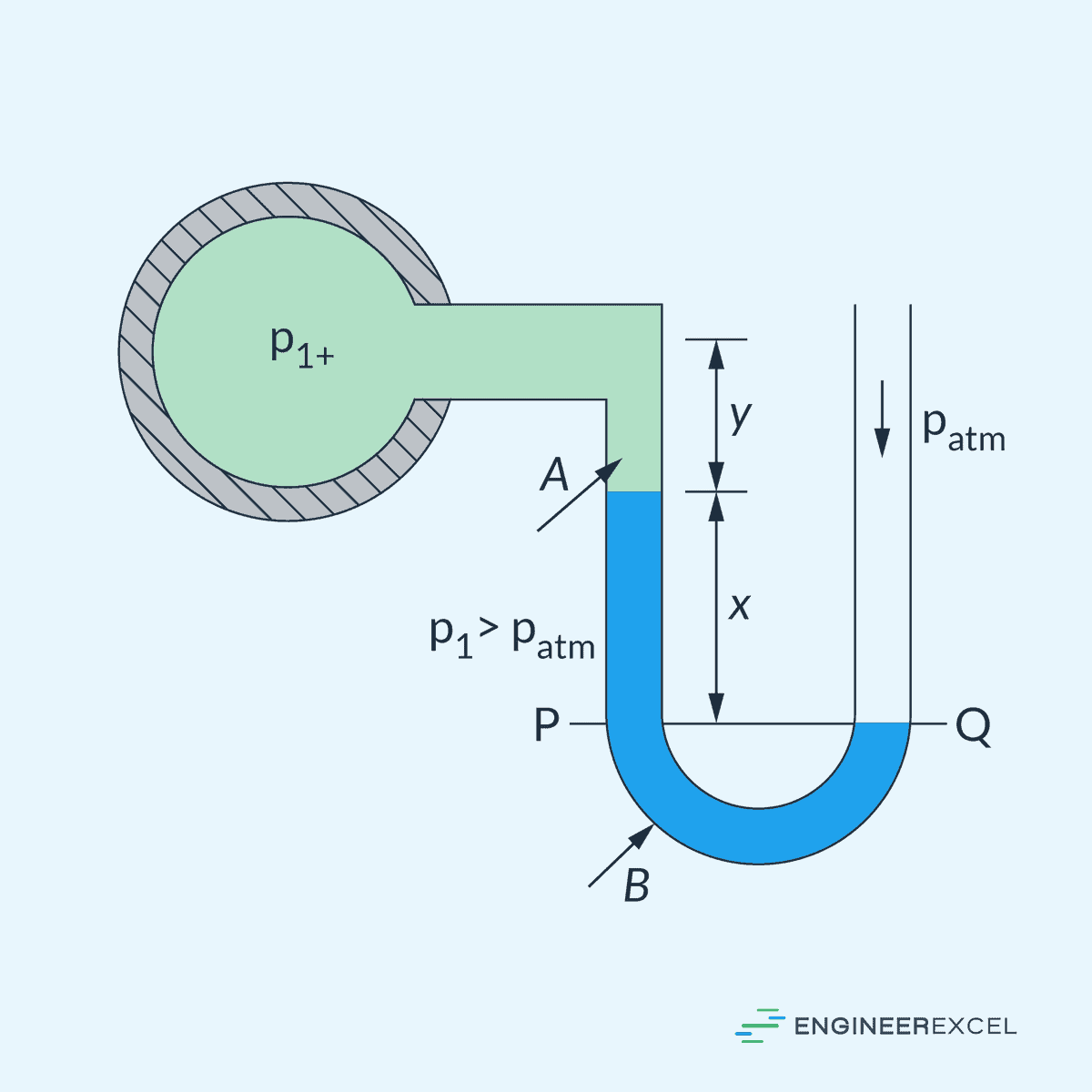
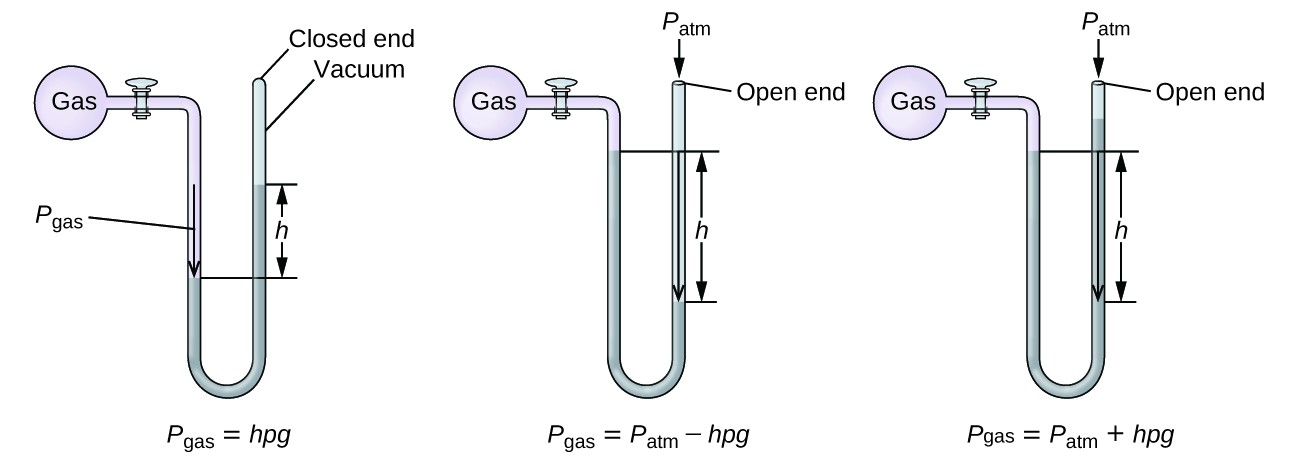
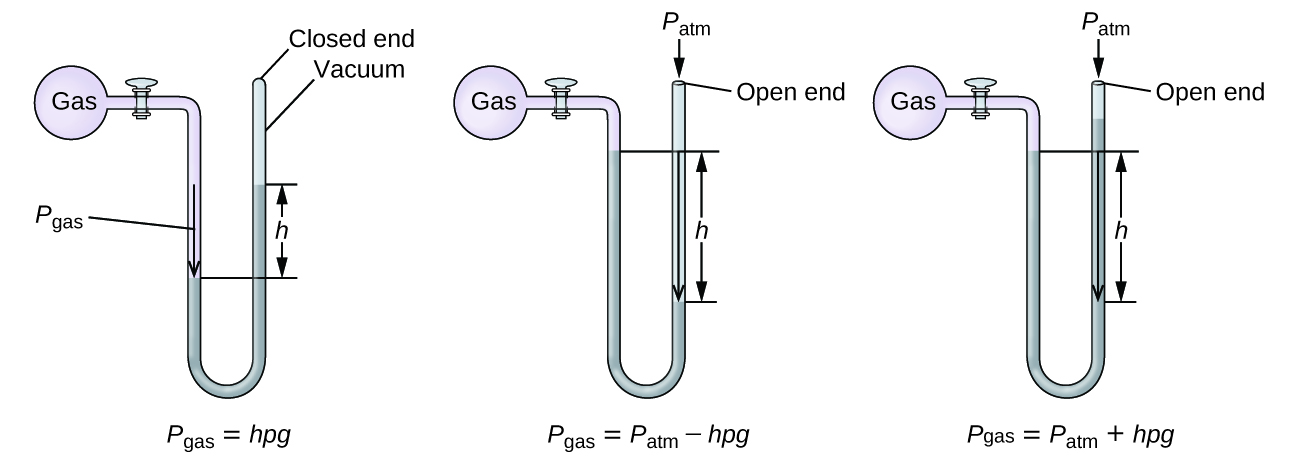
A simple manometer consists of:
- a U-shaped glass tube,
- partially filled with a liquid (commonly mercury or coloured water),
- one end connected to a gas supply,
- the other end open to the atmosphere (or connected to another gas).
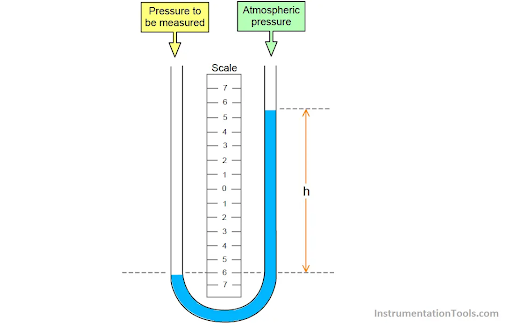
[Insert labelled diagram of a U-tube manometer]
How a Manometer Works (Principle)
- Pressure applied to one side of the manometer pushes the liquid down on that side.
- The liquid rises on the other side.
- The difference in height of the liquid columns represents the pressure difference.
Key idea:
Greater pressure difference → greater height difference.
Using a Manometer to Measure Pressure
Case 1: Gas Pressure Greater Than Atmospheric Pressure
- Liquid level on the gas side goes down.
- Liquid level on the open side goes up.
- The vertical height difference h is measured.
[Insert diagram showing gas pressure greater than atmospheric pressure]
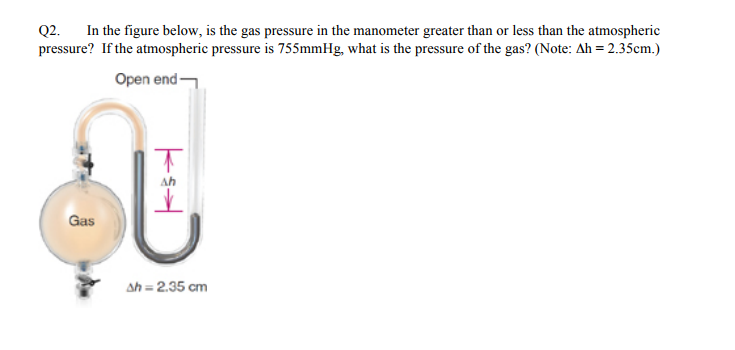
Case 2: Gas Pressure Less Than Atmospheric Pressure
- Liquid level on the gas side goes up.
- Liquid level on the open side goes down.
[Insert diagram showing gas pressure less than atmospheric pressure]
Quantitative Relationship (BGCSE Level)
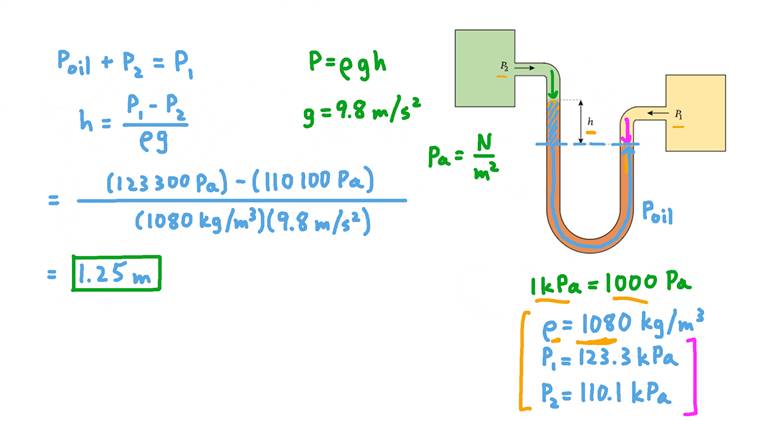
The pressure difference measured by a manometer is given by:
Where:
- P = pressure difference (Pa)
- ρ (rho) = density of the liquid (kg m³)
- g = gravitational field strength (≈ 10 m s²)
- h = vertical height difference between the liquid columns (m)
Worked Example (Simple)
A manometer contains water of density 1000 kg m⁻³.
The difference in liquid levels is 0.20 m.
Calculate the pressure difference.
Solution
Uses of a Manometer
A manometer is used to:
- measure gas pressure in laboratories,
- check pressure in sealed containers,
- measure pressure differences in ventilation systems,
- demonstrate pressure concepts in physics experiments.
Summary Table (Exam-Ready)
| Feature | Description |
|---|---|
| Instrument | Manometer |
| Shape | U-shaped tube |
| Liquid used | Mercury or coloured water |
| Measures | Pressure or pressure difference |
| Key reading | Height difference of liquid columns |
Common Examination Errors (Examiner Insight)
Students often:
- measure height along the tube instead of vertical height,
- forget to convert cm to m,
- confuse manometer with a barometer,
- ignore which side has higher pressure.
Always identify which pressure is greater before explaining.
Exam-Style Questions (Original)
Question 1
What is a manometer?
Question 2
Describe the construction of a simple manometer.
Question 3
Explain how a manometer can be used to measure gas pressure.
Question 4
A manometer shows a liquid height difference of 15 cm.
If the liquid has a density of 1000 kg m⁻³, calculate the pressure difference.
(Take .)
Worked Solutions (Beyond Excellent)
Solution 1
A manometer is an instrument used to measure pressure or pressure difference using a column of liquid.
Solution 2
It consists of a U-shaped tube partially filled with liquid, with one end connected to a gas source and the other open to the atmosphere.
Solution 3
Gas pressure pushes the liquid down on one side, causing it to rise on the other side. The height difference of the liquid columns indicates the pressure difference.
Solution 4
End-of-Objective
A learner who has mastered this objective can:
- describe the structure and function of a manometer,
- use it to compare pressures accurately,
- apply P=ρgh correctly,
- apply correctly,
- explain manometer readings confidently in exams.
What Is a Manometer?
A manometer is an instrument used to measure pressure, especially:
- gas pressure,
- pressure difference between a gas and the atmosphere,
- pressure difference between two gases.
It works by comparing pressures using a column of liquid.
Construction of a Simple Manometer
A simple manometer consists of:
- a U-shaped glass tube,
- partially filled with a liquid (commonly mercury or coloured water),
- one end connected to a gas supply,
- the other end open to the atmosphere (or connected to another gas).
[Insert labelled diagram of a U-tube manometer]
How a Manometer Works (Principle)
- Pressure applied to one side of the manometer pushes the liquid down on that side.
- The liquid rises on the other side.
- The difference in height of the liquid columns represents the pressure difference.
Key idea:
Greater pressure difference → greater height difference.
Using a Manometer to Measure Pressure
Case 1: Gas Pressure Greater Than Atmospheric Pressure
- Liquid level on the gas side goes down.
- Liquid level on the open side goes up.
- The vertical height difference h is measured.
[Insert diagram showing gas pressure greater than atmospheric pressure]
Case 2: Gas Pressure Less Than Atmospheric Pressure
- Liquid level on the gas side goes up.
- Liquid level on the open side goes down.
[Insert diagram showing gas pressure less than atmospheric pressure]
Quantitative Relationship (BGCSE Level)
The pressure difference measured by a manometer is given by: